

Student Mental Health Is Academic Success: A Regulation-First Approach for Texas Schools

Here's something we know for sure: you can't separate mental health from academic performance. They're not two different things competing for our attention: they're deeply interconnected parts of the same story.
And across Texas, that story is becoming impossible to ignore.
Texas schools serve more than 5.5 million students across 1,207 districts, representing some of the most diverse cultural, linguistic, and socioeconomic backgrounds in the nation. These aren't just numbers on a spreadsheet. They're real kids sitting in real classrooms, navigating real challenges every single day.
Statewide data continues to paint a critical picture:
60.4% of Texas students are economically disadvantaged
19% of students are chronically absent
Over 578,000 students received disciplinary actions
42.4% of students reported persistent sadness or hopelessness
These figures reflect more than educational trends: they reveal the growing connection between mental health, engagement, the ability to self-regulate, and academic performance. When students struggle emotionally, academically, or behaviorally, the root cause is often stress, anxiety, trauma, grief, or sensory overwhelm: not a lack of ability or effort.

Why Regulation-Centered Supports Aren't Optional Anymore
Let's be real: learning requires way more than curriculum. A student can have the best teacher, the most engaging lesson plan, and all the resources in the world: but if their nervous system is in fight-or-flight mode, none of it matters. Their brain literally cannot access the higher-level thinking needed for learning.
Students must feel:
✔ Psychologically safe : knowing they won't be judged or punished for struggling ✔ Emotionally supported : having access to adults who "get it" ✔ Nervous-system regulated : able to calm down and refocus when overwhelmed ✔ Sensorily balanced : not overstimulated or shut down by their environment
Yet statewide staffing shortages make individualized mental health support increasingly difficult. Counselor ratios far exceed recommended levels, psychologist and social worker access is limited, and many students needing early support go completely unnoticed until a crisis occurs.
Schools need preventative, accessible, school-connected solutions that complement (not replace) existing mental health professionals. That's where mental health solutions and school wellness spaces come in: not as luxuries, but as essential infrastructure.
How 2 Inspire Peace Supports Texas Schools Through Proven Frameworks
2 Inspire Peace is proud to announce its ongoing collaboration with Texas school districts to strengthen student wellness through programs that align with the Texas Education Agency's Statewide Plan for Student Mental Health, the Safe and Supportive Schools Program (SSSP) framework, and Multi-Tiered Systems of Support (MTSS) models.
Our approach isn't about adding more to educators' plates. It's about creating sustainable, regulation-centered environments that work with existing systems to support students where they are.
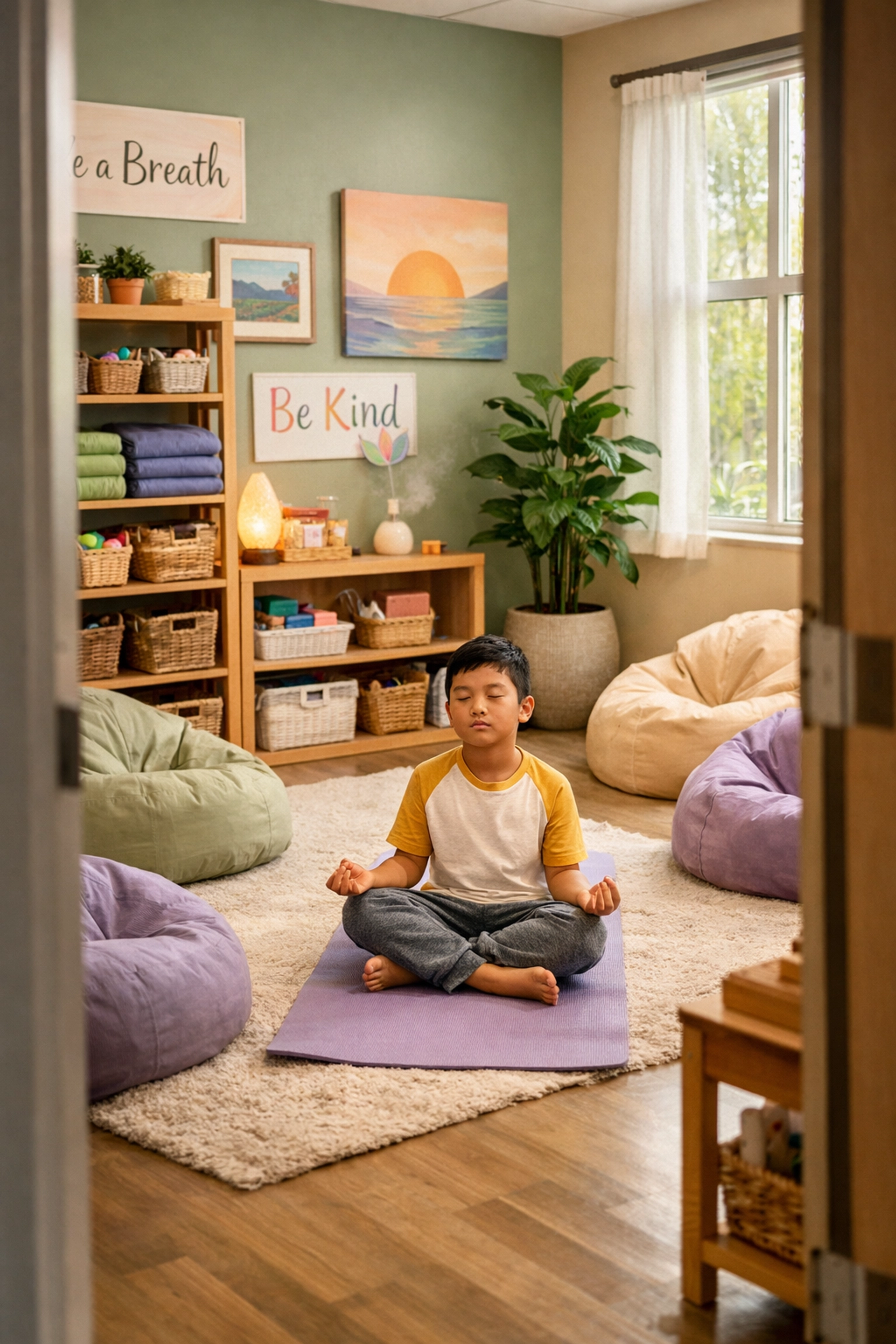
Tier 1 – Universal / Preventative Supports
Think of Tier 1 as the foundation: the supports available to every single student before challenges escalate.
We help strengthen positive school climate through immersive, thoughtfully curated environments like:
Zen Dens & Serenity Suites
Sensory-supportive spaces designed for nervous-system stabilization
Mindfulness & regulation tools that students can access independently
Emotional intelligence practices woven into daily routines
These environments function as nervous-system stabilizers. When a student feels overwhelmed, anxious, or dysregulated, they have a designated space to ground themselves, breathe, and reset: allowing them to return to learning with greater focus and emotional capacity.
Learn more about how DeSoto ISD created Zen Dens on every campus to honor the need for accessible regulation spaces.
Tier 2 – Targeted / Early Intervention Supports
Tier 2 is where we catch students who need a little extra support: before they reach crisis level.
We provide small-group, regulation-centered experiences through SEL programming that includes:
Drumming & rhythmic regulation : using rhythm to synchronize the nervous system
Creative expression & emotional processing : giving students safe outlets for big feelings
Breathwork & grounding techniques : teaching practical tools for self-regulation
Social-emotional skill building : strengthening communication, empathy, and conflict resolution
These sensory-integrated modalities are especially effective for students who struggle with traditional talk-based interventions. For kids who can't always say what they're feeling, hip-hop and healing approaches offer powerful alternatives.
Tier 3 – Intensive / Supportive Pathways
While specialized clinical care may occur outside school settings, campuses still play a critical role in supporting students with intensive needs.
We help schools:
Reinforce referral-friendly cultures that reduce stigma around mental health
Support prevention & de-escalation strategies for staff
Provide trauma-informed training that honors student experiences
Complement the efforts of counselors, psychologists, and specialists
Our restorative practice approach ensures that even students with the highest needs feel seen, supported, and connected to their school community.
Addressing Absenteeism & Behavior at the Root
Here's something we need to talk about more openly: chronic absenteeism and disciplinary incidents are often tied to unmet emotional and regulatory needs.
Behavior communicates.
Withdrawal communicates.
Avoidance communicates.
When a student skips school repeatedly, it's rarely about laziness. When a student lashes out in class, it's rarely about defiance. More often, it's about a nervous system that's overwhelmed, a home life that's unstable, or emotional pain that has nowhere else to go.
2 Inspire Peace programs center on a regulation-first philosophy: helping students build internal stability that becomes the prerequisite for learning, focus, and healthy social interaction. When students have calming space ideas that actually reduce referrals, behavior issues decrease naturally because the root cause is being addressed.
This isn't about being "soft" on discipline. It's about being smart about prevention.
A Prevention-Centered Approach to Student Wellness
Let's say it clearly: mental health support is not separate from academic outcomes. It is foundational to them.
When students feel safe, regulated, and supported, schools see measurable improvements in:
✔ Engagement : students show up (physically and mentally) ✔ Attendance : chronic absenteeism drops ✔ Emotional resilience : students bounce back from challenges faster ✔ Classroom behavior : disruptions decrease, learning time increases ✔ Learning readiness : students can actually access the instruction being provided
As part of our commitment to building resilient schools and communities, we hope to inspire more districts to recognize that investing in student mental health isn't a "nice to have": it's mission-critical infrastructure for academic success.
If your district is ready to explore school wellness spaces, SEL programming, or mental health solutions that align with TEA frameworks, explore our services or reach out to learn how we can support your campus community.
References & Citations
Data and framework guidance referenced from:
Texas Education Agency (TEA) Texas Statewide Plan for Student Mental Health
Student Population & Demographics Texas Education Agency. Public Education Information Management System (PEIMS) Data, 2024–2025.
Academic Performance Indicators Texas Education Agency. State of Texas Assessments of Academic Readiness (STAAR) Results, 2023.
Chronic Absenteeism Data Texas Education Agency. PEIMS Attendance Data, 2023–2024.
Disciplinary Actions & Substance Abuse Trends Texas Education Agency. PEIMS Discipline Data, 2024–2025.
Youth Mental Health Indicators Texas Department of State Health Services. Texas Youth Risk Behavior Surveillance System (YRBSS), 2023.
School Mental Health Staffing Ratios Texas Education Agency. PEIMS Staff FTE Counts, 2023–2024.
School Psychologist Ratios National Association of School Psychologists (NASP), February 2025.
Frameworks & Implementation Guidance
Texas Education Agency. Safe and Supportive Schools Program (SSSP)
Texas Education Agency. Texas School Mental Health Toolkit
Texas Education Agency. Multi-Tiered Systems of Support (MTSS) Framework


Comments